
What is mentoring?
If someone asked you to name your best mentor, could you? Maybe tricky. How about if you were asked to name the person you learned the most from? What made that relationship meaningful? Was it the way they taught new concepts? Was it their wealth of personal experience? Was it their patience when you struggled with confidence or retaining information? Were they a source of frustration and motivation? More than likely, in some way, that person was a mentor to you.
Mentoring for me is the simple concept of helping someone put together the pieces of a puzzle in a way they can understand and replicate.

There are a few ways mentors help with this:
-When we already have the pieces and we just need help putting them together.
-When we're missing pieces and need help finding them.
-When we don't know if what we're holding is a piece to this puzzle.
I think a mentor needs to be more biased than a coach, more flexible than a teacher, and more motivational than a facilitator.
Over the years I have learned to respect the mentor/mentee relationship, having been on both sides each with their own successes and failures.
My worst sessions (bad time management, poor learnings, etc) as a mentor and as a mentee were when the mentor wasn't able to actually do mentoring. The desire was there but the ability was not. It happens. Other things are distracting, like our mood, our other work, or our empty stomach.
I learned that mindfulness is something you should practice as a mentor before you even start your first mentoring session. After having two consecutive sessions where I was the mentor unable to actually mentor I made a flowchart for myself. Having the awareness that I'm going into a less than ideal situation gives me more options than "just do it".
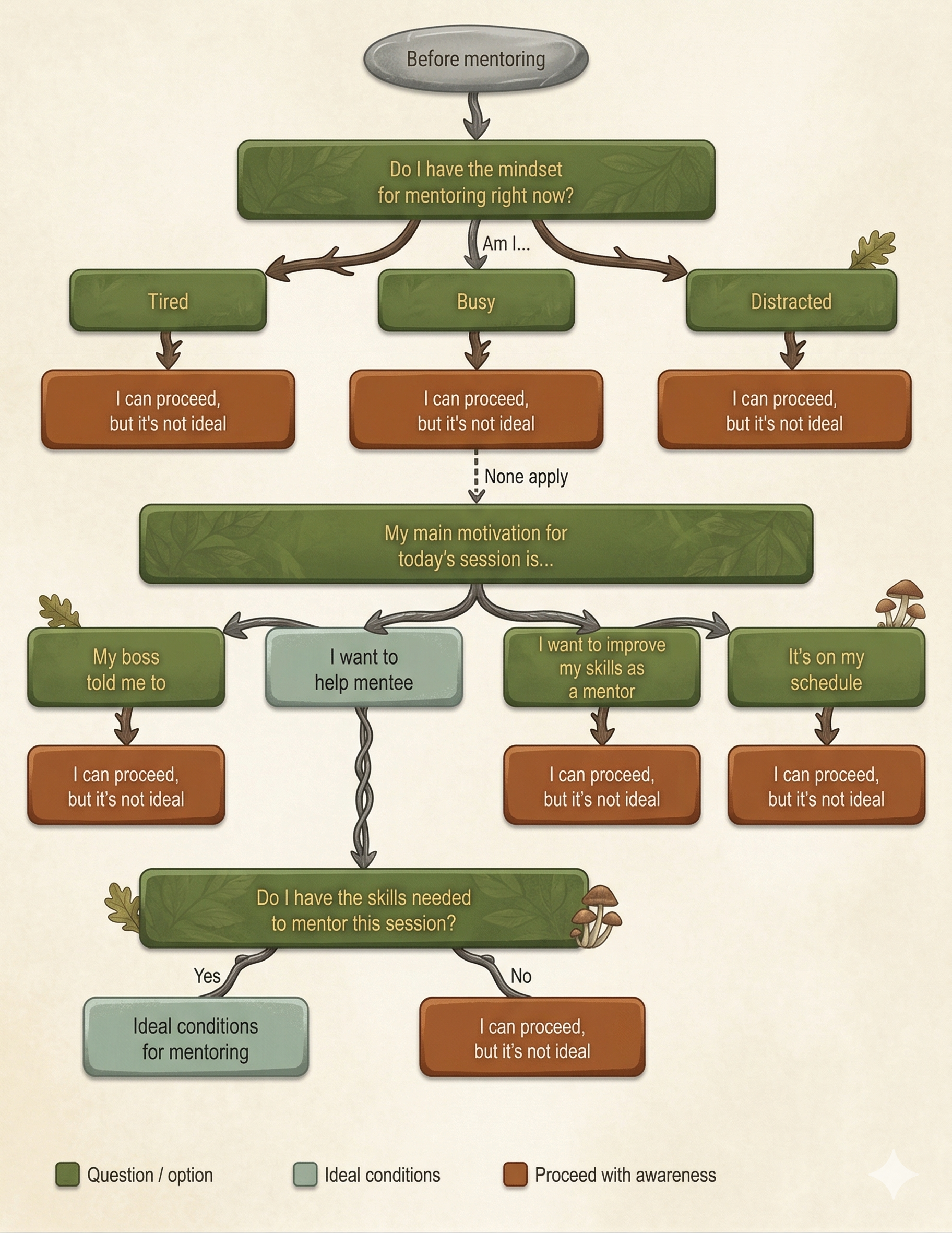
Using this chart has helped me decide if the session needs to be rescheduled, canceled, or maybe reworked. Being honest about your situation to your mentee gives them a voice in how they want to spend their time as well.
Sometimes we really do have to power through no matter how tired or otherwise incapable we are. When that happens, often we don't recognize that we're missing a crucial piece of the puzzle for effective mentoring. So let's take the time to properly acknowledge our situation and make adjustments to content, timing, and even our expectations as needed.