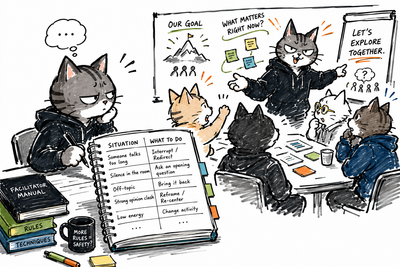
Many of the best innovation stories begin the same way: someone tried something, it didn't work, and something unexpected happened anyway. Think about 3M who was working on developing an ultra-strong adhesive for use in aircraft construction, and ended up giving birth to Post-It notes.
I had one of those moments recently while facilitating a session with a client team. In the moment, I told myself, "Well tried — at least it wasn't a disaster." I even reframed the exercise mid-debrief to make it land more smoothly for the participants. I thought I'd salvaged a weak experiment and moved on.
What I didn't know was the change it had quietly set in motion. I had to wait two weeks to find out.
Try, experiment, fail. At the very least you will learn. At the very best, you will innovate.
The Context, the Intent, and the Experiment
I've been working with this team for over a year. My coaching focus has been helping the leader step into their role more fully — so the team can grow in autonomy, collaboration, and performance.
The leader faced a recurring challenge: they genuinely wanted team members to emerge as natural leaders and take ownership of operations, but that desire kept running into resistance. Watching their meetings over the months, I noticed a pattern. The leader was holding the space heavily, leaving little room for others to step up. And whenever time pressure mounted, they would intervene — making sense of the conversation, driving toward conclusions, pulling the team across the finish line.
My hypothesis: the leader was unconsciously protecting the team from failure, because they felt accountable for business results. Understandable. But it was also quietly preventing both individual and collective growth.
When the team held their monthly face-to-face gathering, I was invited to facilitate the opening and support their retrospective. I was asked to come up with an icebreaker. I came up with something new.
I built a deck of cards. Each card described a "disease" and its "medical prescription" — behaviors that, in practice, improve participation, inclusivity, collaboration, and focus in meetings. Think: actively inviting quiet voices in, or summarizing what's been said before moving on. Each participant would receive a card at the start, keep it secret, and play out their assigned role during the retrospective. The debrief would then invite reflection: What did you notice? How did your awareness of the team shift? What can you take from this into the rest of today?
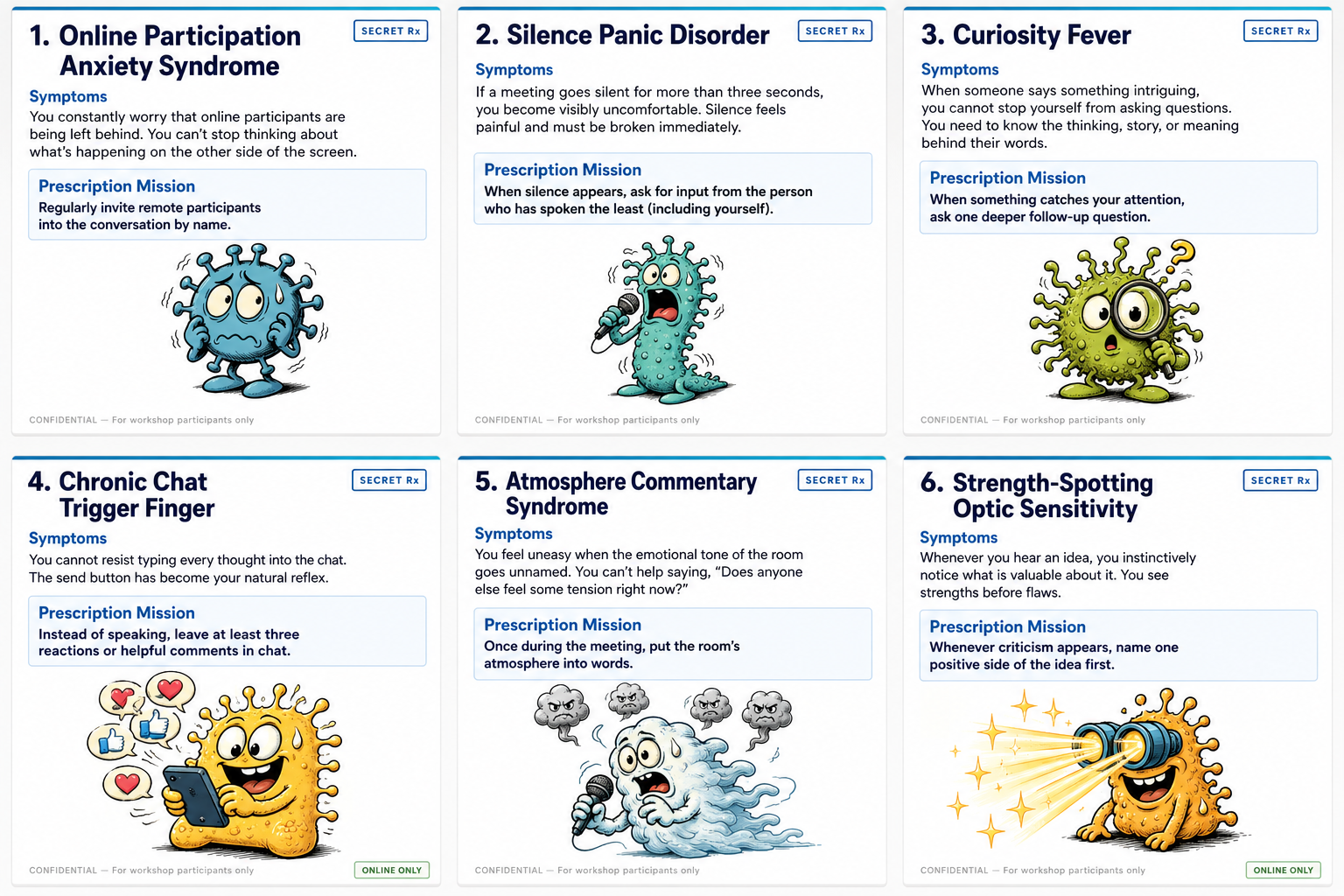
My intention was simple: by packaging these behaviors as a game, I could give each person a lived experience of what effective conversations actually require — and make that learning feel personal rather than theoretical.
The Failure (and the Reframe)
The first problem was practical: the cards were printed in small font and were hard to read. But that wasn't the real issue.
Participants were focused on the retrospective content itself. Most didn't know where or how to weave their assigned behavior into the conversation. One person had been given the role of actively drawing out quieter participants — and ended up being the most silent person in the room.
By midpoint, it was clear: the cards weren't landing. They weren't creating the memorable, embodied learning I'd hoped for.
So I made a decision. I would reframe before the debrief.
I'd also been watching the leader closely during the retrospective. Despite everything, they were still falling into the same protective mode — making directive interventions to ensure something concrete came out of the conversation. They were simultaneously taking notes, monitoring the clock, tracking energy levels, holding the thread of sense-making, and anticipating possible next steps. Everything, all at once.
That observation became the pivot point.
As we moved into the debrief and participants revealed their cards, I made one statement:
"I gave each of you a role — a specific behavior that's genuinely important for better participation, collaboration, and outcomes. It may not have worked the way I hoped. But I want you to notice something: all of these roles? Your leader is playing all of them, all at once, every time. Is that really where you want their energy going?"
The room shifted. Team members began talking about what they actually wanted from their leader — less operational control, more focus on vision and strategy. They said, clearly, that they could handle the rest themselves, if given the space to do so.
The Follow-Up: When the Change Actually Happened
The session ended with concrete commitments: the team would take more ownership over operations, meeting rhythm, and structure. But because my original design had essentially failed — or at least, hadn't proved my assumptions right — I was cautious. Commitments made in rooms don't always survive contact with the following Monday.
I gave it time.
A few weeks later, I had a 1to1 call with the leader to reflect on what had unfolded since. Their opening line surprised me: "Huge progress. The delegation finally happened."
This was something we'd been working toward for months. The team had consistently resisted taking on extra responsibility. The leader had consistently struggled to let go and trust the team to take initiative, make mistakes, and learn. Both patterns had been stubborn.
And now, in the weeks after a facilitation exercise that "didn't work," both had shifted. Not just because the team had decided to act — but because the leader had finally made a distinction they hadn't been able to make before: which roles were theirs to hold, and which ones they needed to release.
What This Means for Facilitators
My disease-and-prescription card exercise didn't work as designed. It was experimental, it was untested, and it was worth trying. But more importantly: it created the conditions for something else to emerge. The failed design gave me a pivot point. The pivot point gave the team a new mirror. And the mirror gave both the leader and the team something they could act on.
Experiment. Stay open to unexpected outcomes. Trust that groups carry more resources than they let on, and that meaning will be made — even when (especially when) your plan doesn't survive the room.
For facilitators, this might be a foundational mindset. But it's worth revisiting.